01LOCAL CONNECTOR
Install the bridge
On the Mac where Codex should return, install the current preview CLI. Use Node 24+ and keep the package README beside you for its compatibility note.
npx --yes @4xeoz/re-entry installOpen the install guide ↗ OpenAI WebMCP ChallengeSleepless KingdomJudge briefing
OpenAI-WebMCP-Challenge / Judge guide
A judge-first path through Sleepless Kingdom and our Re-entry vision: one persistent world, one meaningful signal, and a return to the work that already has context.
Read the latest shelter state before choosing the next bounded step.
START HERE / FOUR MOVES
Follow this order when you are judging the submission. It separates the connector and consent setup from the game story, so every visible step has a clear purpose.
On the Mac where Codex should return, install the current preview CLI. Use Node 24+ and keep the package README beside you for its compatibility note.
npx --yes @4xeoz/re-entry installOpen the install guide ↗In the Host flow, create the signed Manifest, review what the later return may do, approve the connected Mac, and keep the opaque binding on the Host.
Read the Host SDK flow ↗Sign in as a demo player, keep the second player visible, and read the shelter, mission, and world-time panels before choosing a mission.
Open Sleepless Kingdom ↗Assign a gatherer to Wood or Rock, leave the page, and let the world continue. A meaningful event becomes one bounded signal; the Agent rereads current state before acting.
Connector package and external Agent activation are preview boundaries; use the linked README and the final hosted rehearsal to confirm the exact release before judging.
THE RE-ENTRY VISION
Web apps usually stop at the page boundary. Our design keeps the business event on the server, carries only the useful context across the gap, and gives the Agent a safe way back into the page that owns the work.
Background work continues, but a new session has to rediscover what happened and what is safe.
Durable domain events are coalesced into one bounded signal; the Agent rereads current state before action.
The server keeps authority, the Agent gets the right context, and the player keeps consequential choices.
WATCH THE STORY
This short video is the fast orientation. The rest of this page gives the exact judge path, boundaries, and links needed to reproduce the meaningful parts.
Keep the video open while you follow the four setup moves above, then use the game path below to see the same idea inside a living world.
Open on YouTube ↗ONE CAUSAL CHAIN
The Game remains authoritative. Re-entry Core carries verified context across the gap, so the Agent can return without turning every backend event into a message.
THE GAME PATH / THREE MINUTES
This is the smallest meaningful game story: create a mission, leave the page, return to a changed world, and let the Agent decide from current evidence.
Read the server-owned snapshot: shelter, soldiers, nearby resources, and world time.
Assign a gatherer to Wood or Rock. The role fixes the tool, route, and return rule.
Leave the page. The server keeps advancing the world, moving the soldier, and recording change.
A seeded monster encounter can destroy exposed cargo. The event history keeps the why visible.
One coalesced signal points the Agent back to the same context. It reads fresh state before deciding.
Need the controls, roles, and Agent prompt in one place?
Open the gameplay guideMORE RE-ENTRY SURFACES
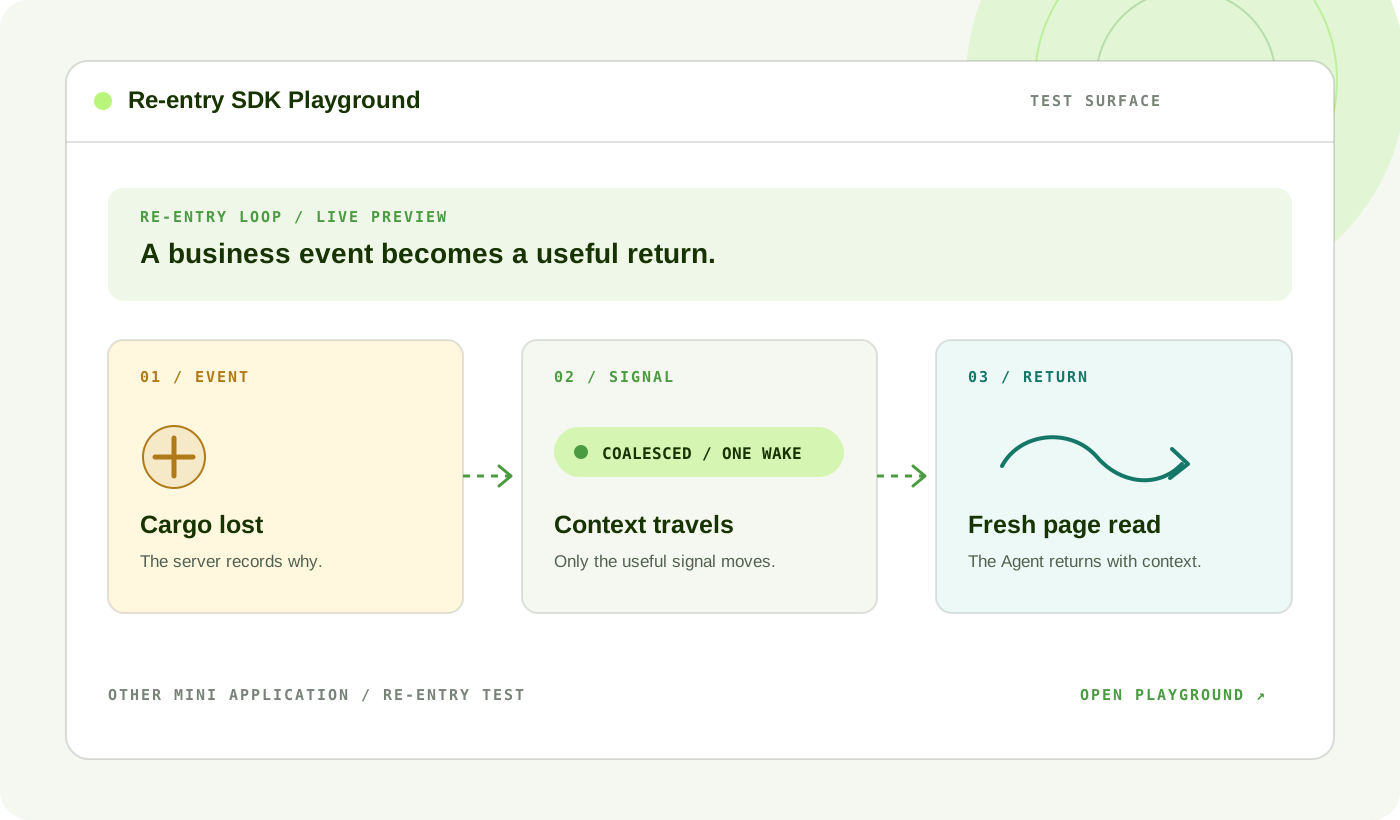
This small surface lets a judge see that Re-entry is a reusable continuity pattern, not a game-only trick. Click the image to enter the playground.
 OPEN PLAYGROUND↗
Other mini application that tests our Re-entry across small, focused workflows.
Enter the playground ↗A focused external surface for testing the Re-entry loop.
THE PAGE SURFACE
The Agent sees a small, purposeful tool surface. Each result is scoped to the signed-in player and checked against the latest server revision.
inspect_shelter_stateReadCurrent shelter, coins, resources, and world time.
inspect_client_snapshotReadThe player-scoped snapshot used by the page.
inspect_missionsReadRole, route, cargo, risk, and next mission state.
inspect_mission_historyReadThe bounded causal record behind the signal.
force_recall_soldierActionA server-checked recall when the live revision permits it.
WHO IS IN CONTROL
Re-entry is valuable because the Agent can make sense of a changed world. It stays trustworthy because each layer keeps a narrow responsibility.
World time, position, mission state, cargo, combat, settlement, and player scope stay on the Game server.
The Agent receives a bounded signal and rereads the authenticated page. It may choose a safe action or do nothing.
Migration, siege, upgrades, and other consequential choices remain visible human decisions with normal server checks.
OPTIONAL AGENT PROMPT
Start with a read-only question. Keep the consequence boundary visible while the Agent rebuilds context.
Read the current shelter state, inspect recent mission history and the latest re-entry event, then explain whether recalling a soldier is safe. Do not issue a consequential command without human confirmation.